
Ensō: Zen Circles
The most powerful symbols are often the simplest.

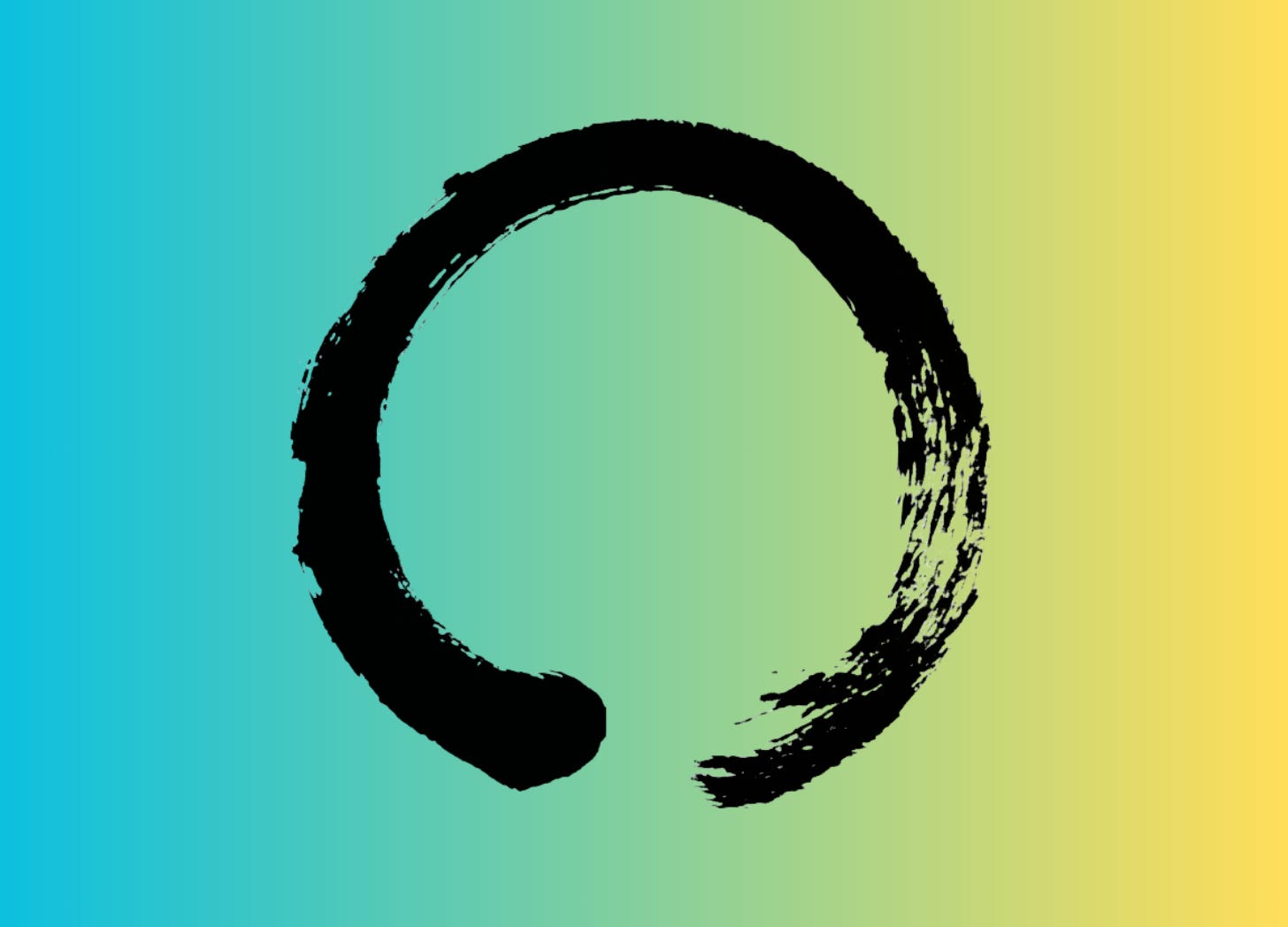
On the surface, the ensō is just a circle. But despite its simplicity, it’s one of the most enduring symbols in Zen Buddhism… which is saying a lot since Zen is a tradition built almost entirely on metaphor and symbolism.
Zen uses symbolism to point toward reality — rather than trying to explain it directly. The idea is to set up the conditions for direct experience, which is the kind of experience you gain only from seeing something for yourself — not from being told something.
It’s that “aha!” moment that appears suddenly and unexplainably.
A useful way to think about Zen symbolism is to think of a map. A map can guide you somewhere, but it is not the place itself.
There are a ton of examples of this in Zen — like the finger pointing at the moon, the sound of one hand clapping, or an empty cup. These are all symbols/metaphors that guide the student to some kind of realization without actually trying to explain the thing itself.
The ensō is one of the purest examples of this approach. A single circle, drawn in a single stroke — and somehow one of the most enduring symbols in all of Zen.
So it’s a little hypocritical of me to try to explain it. But I’m going to anyway, for two reasons.
Explanation only goes so far. Even the best description of the ensō stays on the surface. The real meaning only arrives when you feel it for yourself.
I’m in good company. Some of the most influential Zen masters of the past few centuries have done the same thing — explained the ensō, at least in part. I’ll borrow from their teachings here.
Here are three classic interpretations. I invite you to consider them lightly — and then go draw some circles for yourself.
1. Enlightenment (Satori)
The ensō is often seen as a direct expression of enlightenment — not as an idea, but as a moment.
It’s drawn in one stroke, without correction or revision. There’s no time to think, adjust, or improve it. It just happens.
What shows up on the page when you paint an ensō is immediate and unfiltered — it’s a reflection of your state in that exact moment of time.
In this way, the ensō isn’t something you perfect. It’s something you reveal. It was always there, just waiting to be expressed on the paper. This revelation is much like the experience of enlightenment according to Zen Buddhism.
Enlightenment, in Zen, isn’t a destination you travel to. It’s not something you earn, build, or achieve. It’s already here — obscured only by the effort of looking for it.
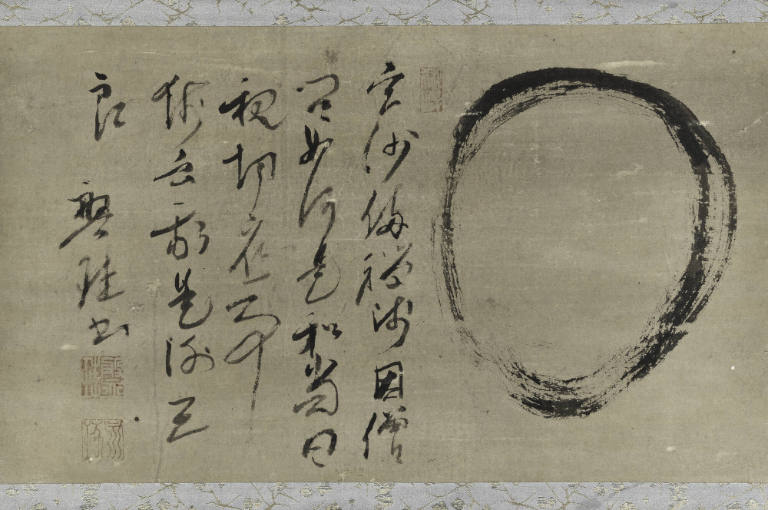
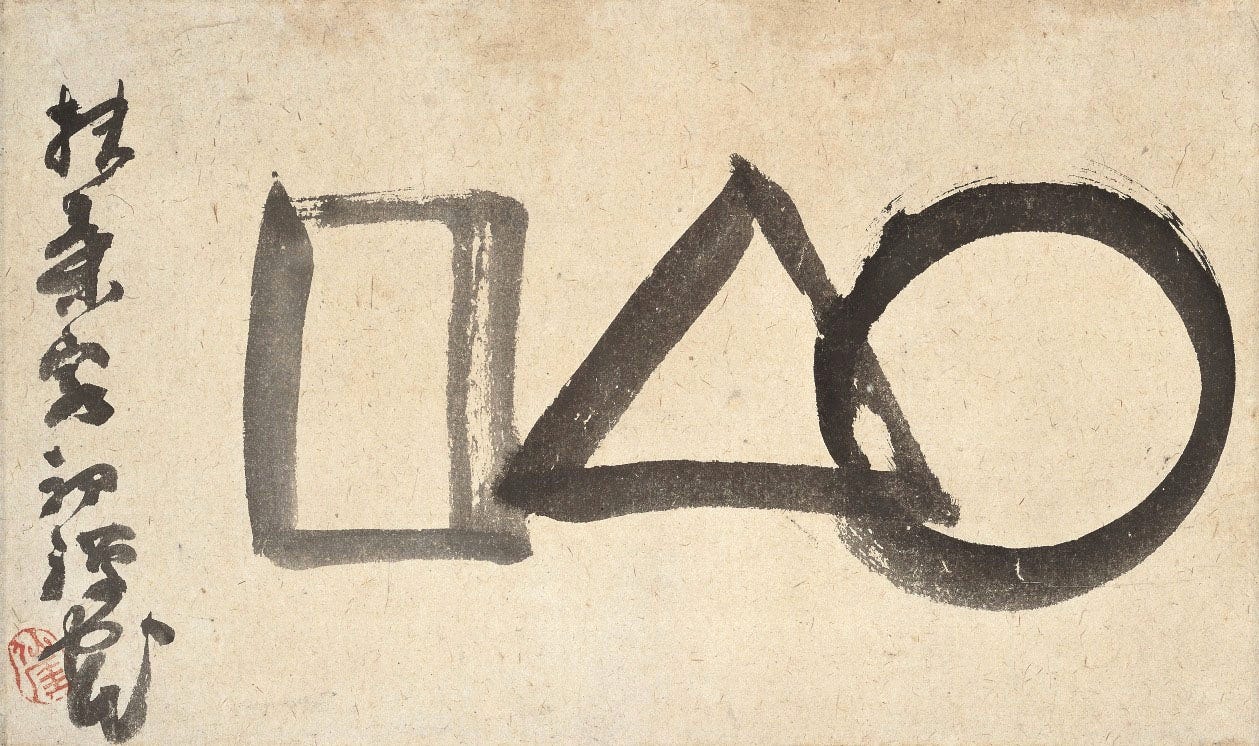
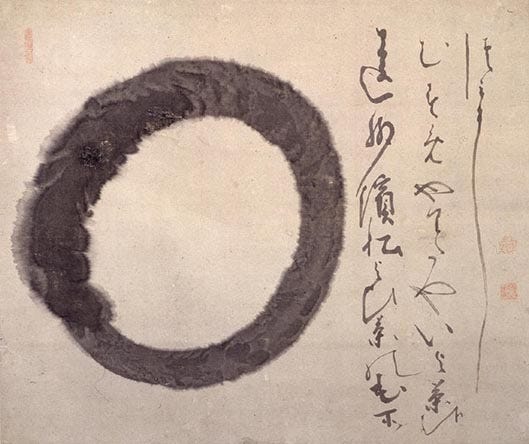
Zen masters like Hakuin Ekaku leaned into this concept by painting bold, imperfect circles and pairing them with questions like: “What is this?” or “Is this a rice cake? The moon? A monk’s bald head?”
The point isn’t to actually answer the question — there is no answer. The point is to catch the mind as it reaches for one anyway.
2. Nothingness (Mu)
Sengai Gibon (1750–1837) was a Rinzai Zen monk who used painting and calligraphy as his primary teaching method.
D.T. Suzuki interpreted Sengai’s circles in his book Sengai: The Zen of Ink and Paper, reading them as “figures of formlessness and infinity.”
Sengai’s ensō pointed toward emptiness — not “nothing” in the usual sense, but the absence of separation.
In Zen, that boundary is seen as something we impose — a way of organizing experience. An expression of duality. That division only exists the moment the line is drawn. Without it, there is just space.
The ensō expresses both at once — the emergence of form, and the emptiness it arises from.
3. Naturalness (Shizen)
Shizen is a Japanese word that translates as “naturalness,” but the meaning is closer to something like “self-so” — that which arises on its own.
It’s the way a child acts, spontaneously and without self-consciousness, before they grow old enough to become performative in their action.
When a child dances, they just dance — there is no performance and no expectations.
Over time, we lose this natural spontaneity. We begin to perform for ourselves and for others. We adjust our behavior around expectations, feedback, and the need to get things right. Our action becomes less “self-so.”
The ensō is a way back. A meditation on spontaneous action.
The rules of the form make this possible. The ensō is drawn in one stroke, quickly, with no correction and no second attempt. There is no time to plan, no opportunity to adjust, no chance to revise. Whatever appears on the paper is what arose — unfiltered and self-so.
Masters like Kazuaki Tanahashi, have practiced this for decades. Each circle is a fresh return to the unselfconscious act and a return to childlike spontaneity.
Read this old Zen koan that offers a similar message.

A Thousand Years of Zen Circles
The first ensō comes from an old Chinese Zen story dating back around 1200 years.
The story goes as follows:
A monk asked Master Isan for a verse expressing enlightenment.
Isan refused, saying it was already in front of him — why bother trying to capture it in brush and ink?
The monk, dissatisfied, turned to Kyozan, another master, and asked for something more concrete. So Kyozan drew a circle on a piece of paper.
This exchange was recorded in the Keitokudento-roku — a foundational Chan Buddhist text compiled in the early 11th century. It marked the first ensō in recorded history.
The ensō traveled from China to Japan along with Zen Buddhism, where it grew into a central element of Zen painting. By the 18th century, nearly every Zen master began producing the ensō as teaching aids for their students.
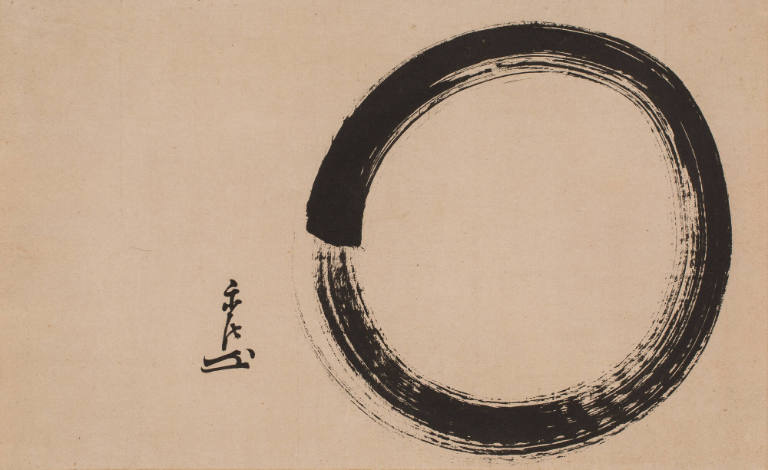
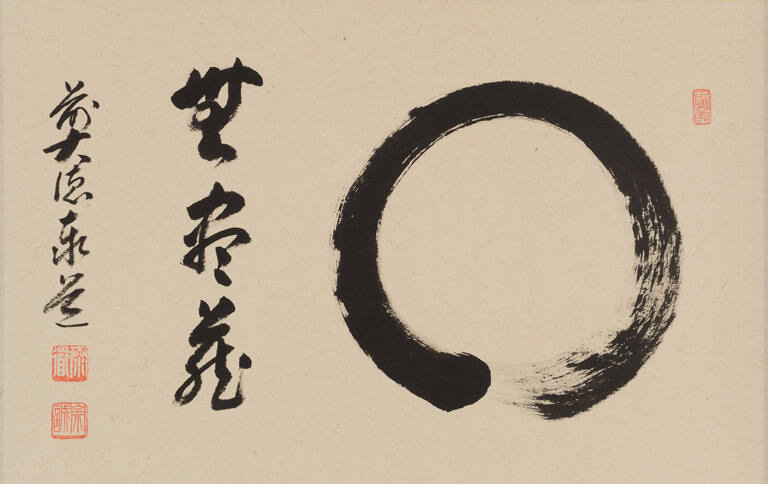
Each circle is different. Some are perfectly closed. Some are left broken. Some are drawn in one stroke, some in two. The method is to draw quickly, freely, and decisively — without room for revision.
I didn't understand the symbolism until I saw someone draw a really big one for our retreat center. It was one beautiful fluid motion.
Pretty sure everyone who read this is going to draw a circle today.