
The I Ching (Book of Changes)
The I Ching is one of the oldest books in the world. Its contents provide a surprisingly accurate, symbolic system for navigating the unseen currents of fate, change, and uncertainty.


My first impression of the I Ching was that it was nonsense — it’s vague, poetic, and deliberately unclear.
I was right... But in a strange way, that’s exactly why it works.
The I Ching isn’t like other books. You don’t read it cover to cover.
While it’s used as a sort of self-help book, it couldn’t be more different from the usual 10-step programs and morning routines you expect to find in these kinds of books.
Some call the I Ching a book of divination, but it doesn’t actually tell the future… it does something way more useful than that…
The Book of Changes
The I Ching is usually translated as “The Book of Changes.”
It’s ancient. The core text predates Taoism by centuries, and Zen by well over a thousand years. Yet its central idea — that everything is in constant motion — became foundational to both.
Nothing holds still. Everything changes. Situations, moods, relationships, empires… everything.
The question is never whether things will change, only which way, and how fast.
The 64 hexagrams serve as a method for mapping that motion. Each one is a snapshot of a particular moment in time — not a thing, but a configuration of forces. When you consult the book, you’re trying to locate yourself on that map — to figure out where you are and which direction the current is running.
Once you can see the current, you can decide whether to swim with it or rest.
The Taoists call this wu wei — effortless action — learning to move with the flow of the universe, rather than trying to fight it.
Consulting The Oracle
Reading the I Ching follows a simple ritual…
First, you begin with a question and three coins.
You toss all three coins at once to generate either a yin line (broken line) or a yang line (solid line).
You then repeat this process until you have six stacked broken/unbroken lines (building from the bottom up).
You then match that pattern to one of the book’s 64 passages and read the corresponding text.
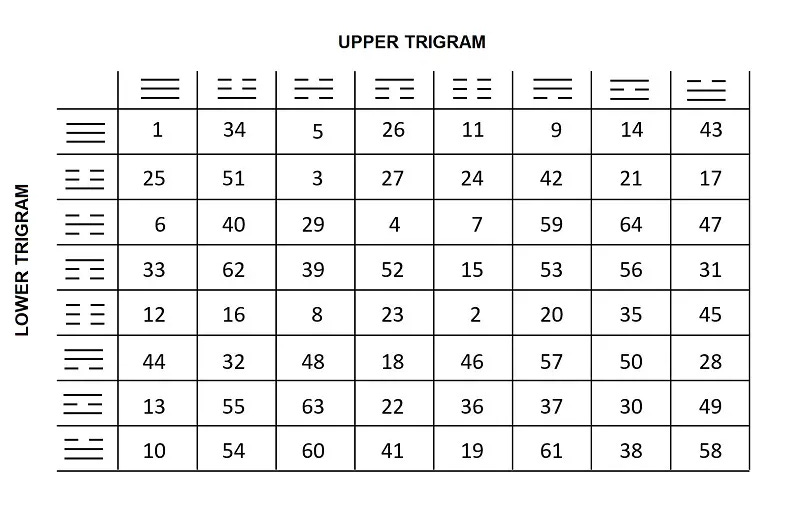
Each passage is cryptic and brief.
The advice listed in its pages shouldn’t make any sense to the reader — yet they always seem to connect and provide clarity or direction to one’s question.
To understand how this might work, we must examine the ideas of Dr. Carl Jung — who was himself a lifelong advocate for the I Ching.
A Synchronicity Machine
“The I Ching does not offer itself with proofs and results, it does not vaunt itself, nor is it easy to approach, like a part of nature it waits until it’s discovered, he who is not pleased by it does not have to use it, and he who is against it is not obliged to find it true, so let it go forth into the world for the benefit of those who can discern its meaning.” — Carl Gustav Jung.
The easy explanation for how the I Ching ‘works’ is that you’re projecting. You bring a question loaded with your own hopes and fears, the book gives you a deliberately ambiguous answer, and your mind fills in the rest.
But Carl Jung, who wrote the foreword to the Wilhelm I Ching translation, saw something more going on. He called the I Ching a kind of “synchronicity machine.”
Synchronicity was his word for a meaningful coincidence — two unrelated events that seem connected in a deeply purposeful way, even though there is no clear cause-and-effect link between them.
Consulting the I Ching forces your mind to do something it doesn’t normally do — to take something external and unrelated, and find meaning in it.
That act of meaning-making is the synchronicity Jung was talking about.
The problem is that most of the time, our thinking is just one thought leading to the next. It follows the same track over and over again in a sort of endless loop.
The reason we can’t find clarity in many of the problems we face is that our problems and our thinking about those problems are made of the same substance. You can never see your situation because you’re living inside it.
The I Ching breaks this loop.
Through clever use of random chance (the coin toss), it provides you with a piece of text that has nothing to do with you and asks you to make it mean something. To do that, you have to step outside your own thinking long enough to look at the situation from a different angle.
The intuition you tried to reach, but couldn’t, surfaces in this act of interpretation.
This is why it’s more than projecting your fears onto an ambiguous page — you’re using that page to reach something you couldn’t reach alone.
The I Ching doesn’t actually contain any answers to your problems — but it’s genuinely good at showing you that you already do.
If you want to try it yourself, check out this short video explainer — all you need is 3 coins, a pen, and a piece of paper.
There are several translations of this book to choose from. This is the one I prefer.