
Ikkyū Sōjun: The Drunken Master
One of the greatest Zen masters in history broke nearly every rule of his tradition.

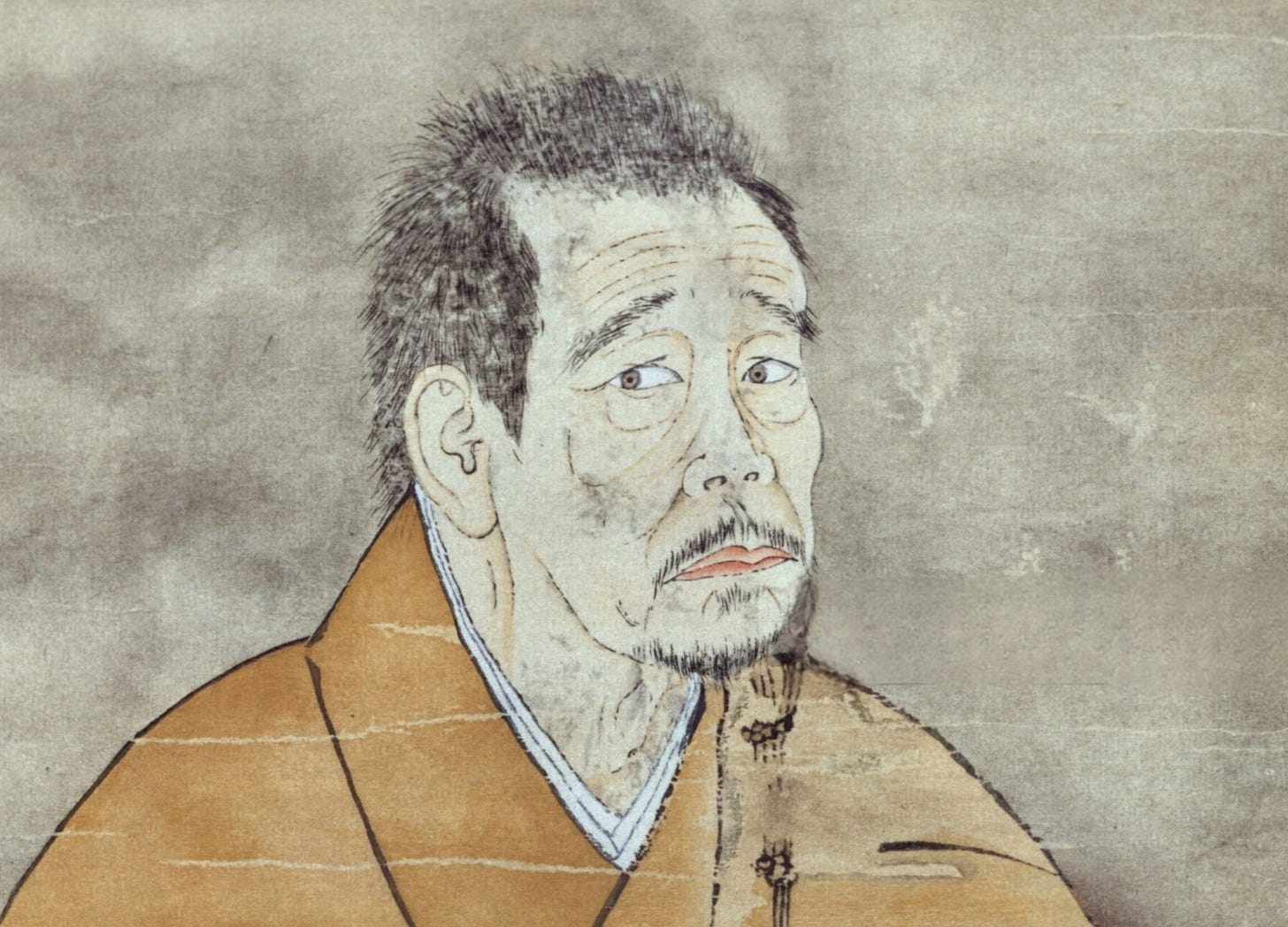
He drank too much. He frequented brothels. He wrote erotic poetry. He’s also remembered as one of the most celebrated Zen masters Japan ever produced.
His name was Ikkyū Sōjun.
Ikkyu’s antics make for a great story. Zen sure loves it’s excentrics. But his transgressions also raise an uncomfortable question:
If one of Zen’s greatest masters spent much of his life breaking the rules, how important were the rules in the first place?
The Blind Donkey of Lake Biwa
Ikkyū was born in 1394 during the Muromachi period in Japan. He’s believed to have been an unrecognized bastard son of an emperor.
He trained for years under a famously austere master at a poor temple by Lake Biwa. He did the full Rinzai grind, koans and all, and finally had his breakthrough one night after hearing a crow’s caw.
His enlightenment released him, but not in the usual way — Ikkyū cast aside his loylty to the rules and traditions of Zen itself. He spent the rest of his life building a legacy as Zen’s most brilliant embarrassment.
He was once appointed as the head of a great Kyoto temple, but after just nine days of work, he quit. Ikkyū was disgusted by the hypocrisy he saw in the monks and told them where they could find him instead — the local brothel.
He was dead serious. Ikkyū was a frequent patron of brothels. He never even attempted to hide it. He walked in still wearing his black monk’s robes. He drank. He whored. He even fell in love, once.
Not only did Ikkyū break the rules, he did so on purpose and in public. He documented his debauchery in a collection of (often erotic) poems called the Crazy Cloud Anthology (Kyōunshū).
If you’re curious about his poetry, I recommend the translations by Sonja Arntzen or John Stevens. The translation from Stephen Berg is also noteworthy, though artistically exaggerated.
Ikkyū signed his poems under all sorts of names — Crazy Cloud, General of Zen, Old Monk, Master of Love, and Blind Donkey.
The blind donkey is a term dating back to the founder of Rinzai Zen. As the story goes, while Linji (Rinzai’s founder) was on his deathbed, he charged his successor to keep his teachings alive. When the man answered by yelling as loudly as he could, Linji remarked that his teachings were sure to “perish with this blind donkey.”
It sounds like a cuss — like he’s insinuating that he was leaving his school to an idiot. But in Zen, the blind idiot who is beyond cleverness is exactly the one who can carry the dharma. In the upside-down logic of Zen, this is actually more of a compliment than a burn.
Idiot or not, it’s not very Zen to chase women, drink… and then brag about it.
But Ikkyū insisted that the brothel was his practice — not something he did in spite of it.
His reasoning had two parts:
1. Desire Is Not A Flaw To Be Excised
Ikkyū was fascinated by human desire. He saw desire as an essential element of human nature — something that couldn’t merely be starved and extinguished.
His arguments follow a similar line of thinking to Carl Jung’s description of the shadow — that pushing these desires deeper and deeper down only causes them to fester into the same hypocrisy he saw all around him within the other monks.
He quit his role at the Kyoto temple after seeing how the monks pretended to have transcended desires they had merely repressed. He thought it better to meet desire openly and see what it actually was than to lie about it.
To him, being human — appetites and all — was not a disqualification from awakening. If anything, it was the only condition under which waking up made any sense.
2. Passion Is Practice
Anyone can feel calm and present while sitting on a cushion in a meditation hall.
Ikkyū didn’t think this counted for very much.
To him, the equanimity one cultivates in a silent room and the equanimity one cultivates in a brothel were identical. But the monk who found stillness in a hall hadn’t truly found stillness — he just found a quiet spot to sit down.
He went even further than that. He thought sex itself, when faced openly, could deepen enlightenment rather than obstruct it.
“Love play can make you immortal. The autumn breeze of a single night of love is better than a hundred thousand years of sterile sitting meditation.”
Stillness either holds everywhere or it doesn’t hold anywhere.
It’s important not to confuse Ikkyū’s approach with Vajrayana tantric traditions.
Ikkyū was not teaching sex as a path to enlightenment. His encounters with pleasure and desire were confrontations with attachment in ordinary life — not esoteric methods meant to transform desire into liberation.
Wooden Zen
Ikkyū wasn’t unique for his contempt toward the Zen Buddhist establishment. Other famous masters like Bankei Yōtaku fought a similar fight — insisting that enlightenment didn’t require any of the rigorous monastic apparatus at all.
Ikkyū just did it in a more… eccentric manner.
Most of Ikkyū’s contempt was directed at so-called “Wooden Zen” — the stylized, but dead practice of monks who had mastered the forms (the robes, the postures, the chants) — but who had lost the fire. They follow the motions, but nothing is happening inside.
To contest this point, he was known to parade the streets waving a wooden sword.
A wooden sword looks identical to a real one while it’s in the scabbard. But the moment you pull it out, you realize you can’t actually cut anything with it.
This is part of the irony surrounding figures like Ikkyū (and Zen in general). The moment we turn a rebellious master into some kind of archetype — the drunken enlightened outlaw, the holy degenerate, the anti-establishment sage — the whole thing hardens into another form of wooden Zen.
Which means using Ikkyū as a justification for compulsive behavior misses the point just as badly as rigid attachment to monastic rules.
Pointing at the Moon
It’s easy to mistake Zen’s rules for its essence. While all of these things have a purpose, Zen doesn’t exactly demand any of it (though Dōgen might disagree).
Strip all that stuff away, and Zen comes down to one thing — realizing one’s true nature. A mind free from attachment, meeting whatever’s in front of it without clinging to it or recoiling from it.
Everything else flows downstream from that. The famous austerities of celibacy, sobriety, and poverty are not commandments per se — they’re more like advice. Cautions about the kinds of compulsions that tend to keep the mind grasping.
Drinking dulls the same faculty Zen practice is trying to sharpen. Hedonistic sex keeps us in the loop of want → chase → want again.
The rules exist for a reason — but they’re the finger, not the moon. This may have been why Ikkyū decided that to truly understand his own nature, he had to cast them aside.
A Word Before You Go to the Brothel
This essay is not an argument to abandon the precepts and engage in a hedonistic lifestyle.
“Zen has no rules, so I can drink and fuck and do whatever I want and it’s all just practice.”
It isn’t…
This is probably the oldest con in spirituality. It’s called “spiritual bypassing“ — it’s the rot that sits at the core of every spiritual tradition.
The reason Ikkyū’s antics weren’t a bypass is because he didn’t bypass them. He’d done the years of hardcore training. He passed the koans. He had the crow’s-caw enlightenment. He did all of it.
Someone who hasn’t done any of that work and walks into the brothel is just at a brothel. And drinking doesn’t make you a free man — even if you read about Zen while you do it…
Ikkyū’s freedom was a release from the self. This is fundamentally different from the bypass version, which is in service to the self. From the outside these look identical — but from the inside they couldn’t be more distinct.
The rules themselves aren’t the point. The rules are like scaffolding. They help hold the building together while it’s under construction. You’re free to take them down once the building stands on its own.
You’re also free to skip them and watch the whole thing collapse under its own weight.
If this sharpened something, a paid subscription keeps the blade moving.
I wonder if Alan Watts was thinking about the drunken master when he took off on his alcoholic fuelled escapes from the ego.
Let us note Li Bai (or Li Po), a Taoist master:
"Li Bai's poems became models for celebrating the pleasures of friendship, the depth of nature, solitude, and the joys of drinking"