
Kill The Buddha
What Zen Buddhism understood about the hidden trap inside spirituality.

A Zen student once asked a master:
“What happens after enlightenment?”
The master replied:
“You chop wood. You carry water.”
The student frowned. “And before enlightenment?”
The master answered:
“You chop wood. You carry water.”
From the outside, Zen looks deeply spiritual. You’ve got monks dressed in robes, pungent incense smoke, ornate temples, and a highly ritualistic meditation practice.
But the deeper you look, the more apparent its hostility towards spirituality itself becomes.
One of the most famous sayings in Zen summarizes this sentiment perfectly:
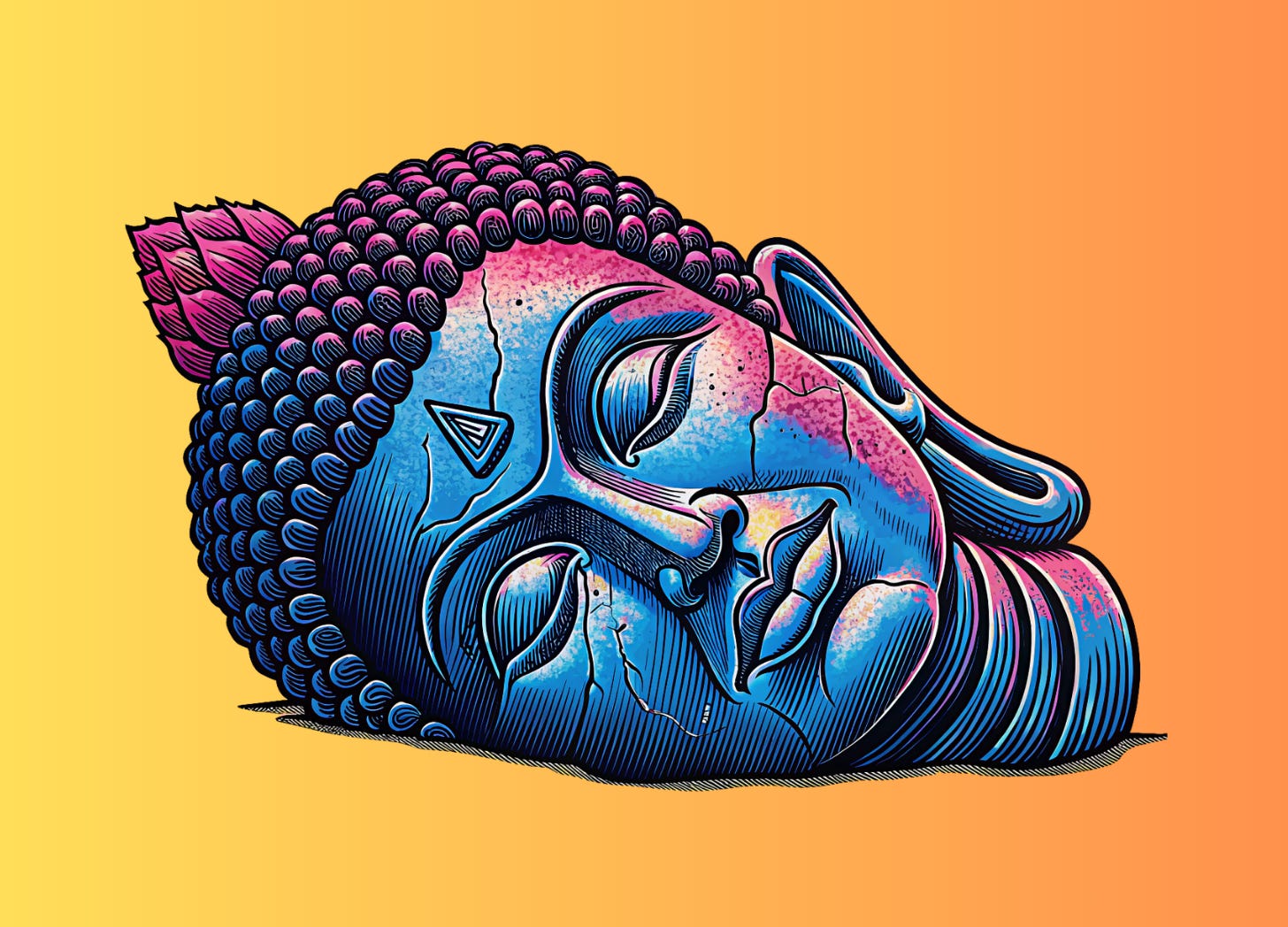
“If you meet the Buddha on the road, kill him.”
This isn’t a Zen being nihilistic or sacrilegious. It’s actually pretty practical advice for what Zen is all about.
The old Zen masters understood the paradox at the center of any spiritual practice — that the attempt to transcend the ego just as easily becomes another project of the ego itself.
Because the one doing the improving is the same one trying to be improved.
Alan Watts always said this would be “like trying to bite your own teeth.”
Here’s the trap laid out plainly:
The more you identify as “spiritual,” the more spirituality itself becomes part of your identity. Instead of dissolving the ego, the ego simply rebuilds itself using more spiritual language.
You stop being a normal person and become “someone who is awake.” Someone evolving. Someone healing. Someone closer to the truth than everyone else.
The Buddha and the imagined state of enlightenment become another possession… Another thing to imitate, perform, chase, and display to others.
Advising us to “kill the Buddha” reminds us that the moment enlightenment turns into something outside yourself — something to attain or cling to — you’ve already lost it.
This doesn’t mean practice is useless. Rituals, meditation, koans, and discipline all matter. They play their role in cultivating clarity and self-observation.
But, ultimately, none of these things are the point.
This resonated with me because it highlights a trap that seems almost unavoidable: turning the search for freedom into another form of attachment. The ego is remarkably adaptable. If it can no longer identify with wealth, status, or achievement, it may simply reinvent itself as the person who is enlightened, awakened, or spiritually advanced.
I especially appreciate the reminder that practice is a means, not an end. Meditation, prayer, study, and ritual can be valuable tools, but they can also become subtle badges of identity if we're not careful. The Zen instruction to "kill the Buddha" isn't a rejection of wisdom; it's a warning against idolizing any idea, teacher, or version of ourselves.
The image of chopping wood and carrying water captures something profound. The ordinary tasks of life don't disappear after insight. What changes is our relationship to them. Perhaps enlightenment isn't escaping reality but meeting it more directly, without constantly trying to turn it into something else.
A thoughtful and humbling reflection. It reminds us that the deepest truths are often found not in extraordinary experiences, but in ordinary moments fully lived.
There is no trap. There is Infinite Consciousness