
The Uncarved Block
Most of us don’t fail because we don’t try hard enough. We fail because we interfere too much.

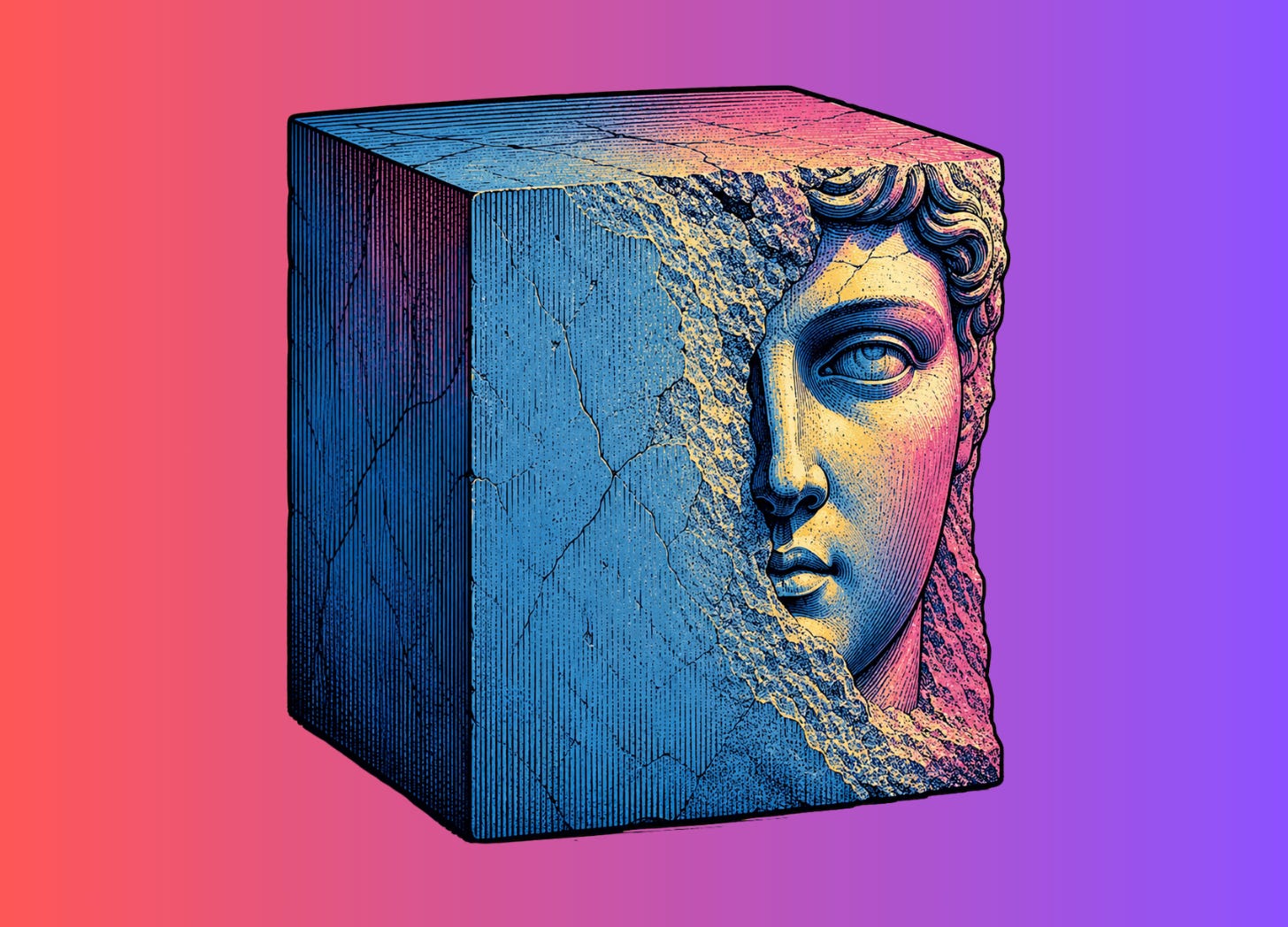
Someone once asked Michelangelo how he made David — his most famous sculpture. He said it was simple — he only removed everything that wasn’t David.
This sounds like the typical non-answer you might expect from a genius like Michelangelo. But he meant it literally — the figure was already in the stone. He didn’t put it there. All he did was take away the excess.
This sentiment is shared by a lot of the world’s greatest makers.
Saint-Exupéry said perfection is achieved not when there is nothing left to add, but when there is nothing left to take away. Miles Davis talked about the importance of the notes you don’t play. Bruce Lee urged people to “hack away at the unessential.”
Most of us creative idiots tend to overcomplicate the act of creation. We think that to make something great, we have to force it — impose our will on the material and beat it into submission.
I exert an ungodly amount of effort into writing posts like this, for example…
But if you watch a master at work long enough, you’ll see how they do the exact opposite.
At some point, they stop pushing. The effort falls away, and the work seems to move through them instead of out of them.
A professional dancer appears weightless as they perform brutal lifts. A skilled musician’s fingers somehow land on the next chord before their mind can even name what it is or why they chose it.
I used to love watching those old Bob Ross videos because the man would basically just dab his paintbrush on canvas and beautiful mountains would just appear.
The Taoists called this wu wei. “Doing without forcing.” Working with the grain instead of against it. Te is the power that results from allowing something to move according to its own nature.
Try and force it, and that power is the first thing to go.
Most of the time, the obstacle in creation isn’t a lack of effort. It’s excessive interference. We do too much. Think too long. We apply too much force to produce something that can only emerge naturally.
To work like Michelangelo and other great creative masters — by removing rather than imposing — you first have to see the figure.
And you can only see what’s actually in the stone once you loosen your attachment to what you want it to become.
The meaning of the uncarved block isn’t about passivity or laziness — but the discipline of leaving things alone long enough for their true nature to reveal itself.
The master is not the one who imposes the most force.
The master is the one who interferes the least.
Funny enough, I kept running into this exact problem while writing this piece itself.
I started writing this months ago with the intention of exploring Lao Tzu’s idea of “pu” — how the uncarved block holds a kind of raw potential precisely because it has not yet been reduced into one fixed form. And how that idea correlates with the Zen concept of the “original face.”
I’ve taken several stabs at finishing this piece over the past few months — only to keep hitting the same wall over and over again.
I was trying to force it when it just wasn’t where this thing naturally wanted to go.
This article is the result that emerged once I stopped trying to force it into what I thought it should be and allowed it to go where it naturally wanted to go instead.
The practical lesson here isn’t to stop trying — it’s to stop choking the process with excessive control.
Most of us begin creating with a finished image already trapped in our heads. We become attached to a particular outcome, then spend the entire process trying to force it into alignment with our vision.
Start moving. Pay attention, but don’t fixate. Remove what feels false. Keep what feels alive. Let the thing gradually tell you what it wants to become.
This is particularly difficult because it requires us to give up control. The ego craves certainty, and we want to feel like we’re the sole architect of the outcomes we create.
But the harder we force something into existence, the more we interfere with the very process that gives it life.
As the amerindian grandfathers say, "happiness is in simplicity; what's difficult is being simple".
Thank you for making this great point! It makes a lot of sense to me and is coherent with much of what i read and experience. Go with the flow. Let life work though you. We are here to experience life. Why not let it work through you without Ego creating resistance.